As part of my networking training, I recently got to work on a redundant WAN topology simulated with GNS3. The lab is built around three sites interconnected via OSPF, to test redundancy and automatic convergence in case of a link failure.
The topology
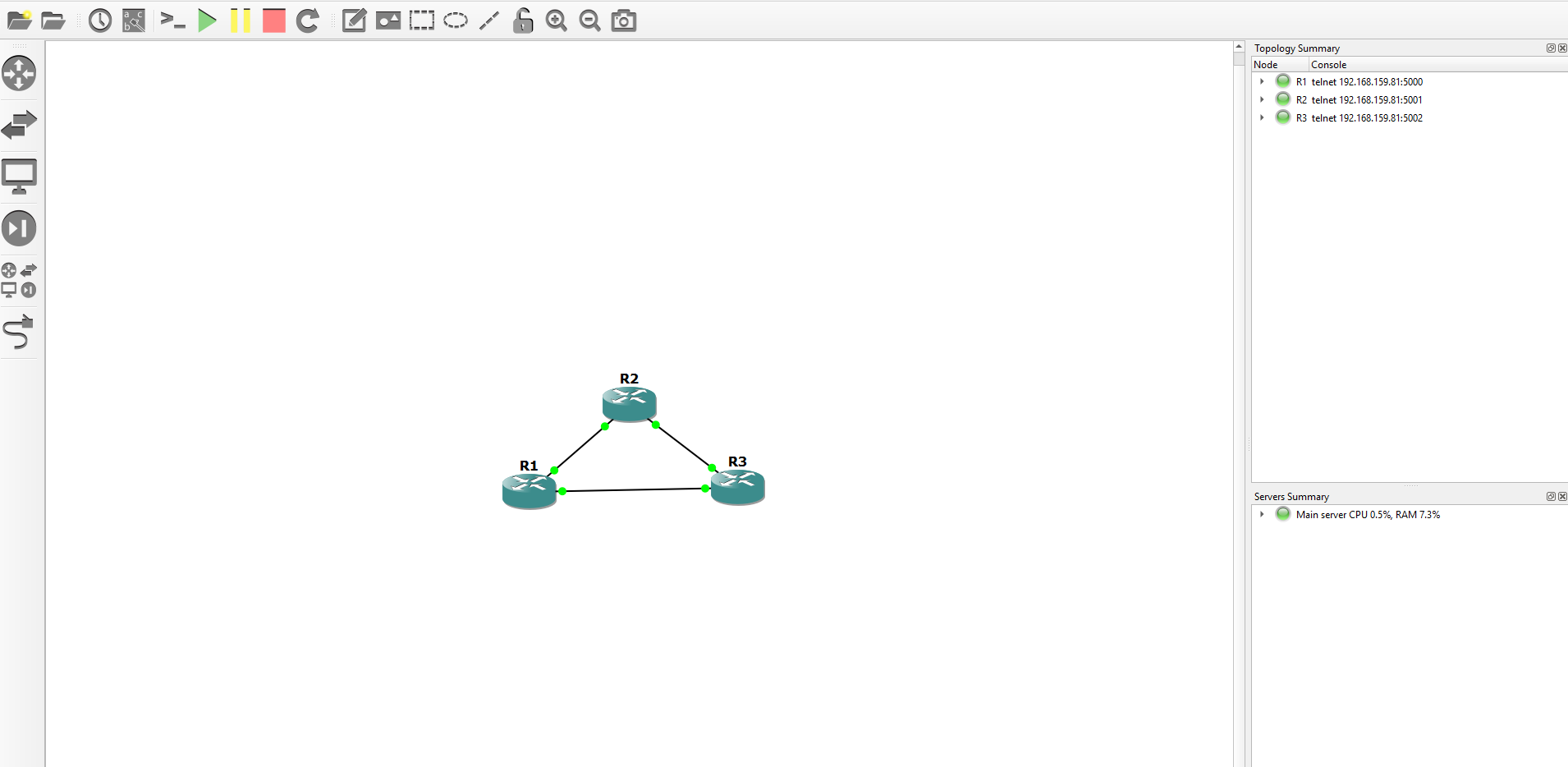
The lab is built on three Cisco C2691 routers connected in a "triangle". This topology is a classic choice for testing redundancy: if one link goes down, traffic must automatically find an alternate path through the third router.
The configuration
To carry out this exercise, I configured each router's interfaces with /24 IP addresses, then enabled the OSPF process on Area 0 (the Backbone). The strength of this configuration is its simplicity: by declaring the connected networks in OSPF, the routers dynamically discover their neighbors and build their routing table.
The results
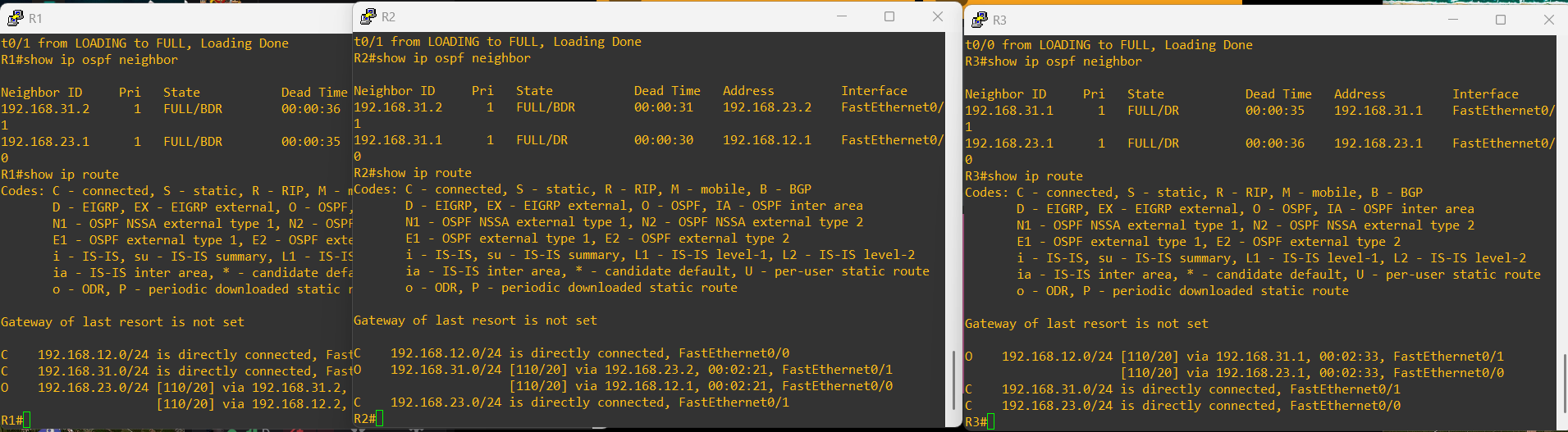
Proof that the configuration works shows up in the routing tables and the state of the adjacencies. As you can see below, all neighbors are in the "FULL" state and remote routes are correctly learned, with even some multipath (ECMP) in play to optimize traffic flows.
Why does it matter?
Redundancy isn't optional in the enterprise. Mastering OSPF means knowing how to build a network that can "self-heal" within seconds. It's a foundational skill for any junior network engineer.